


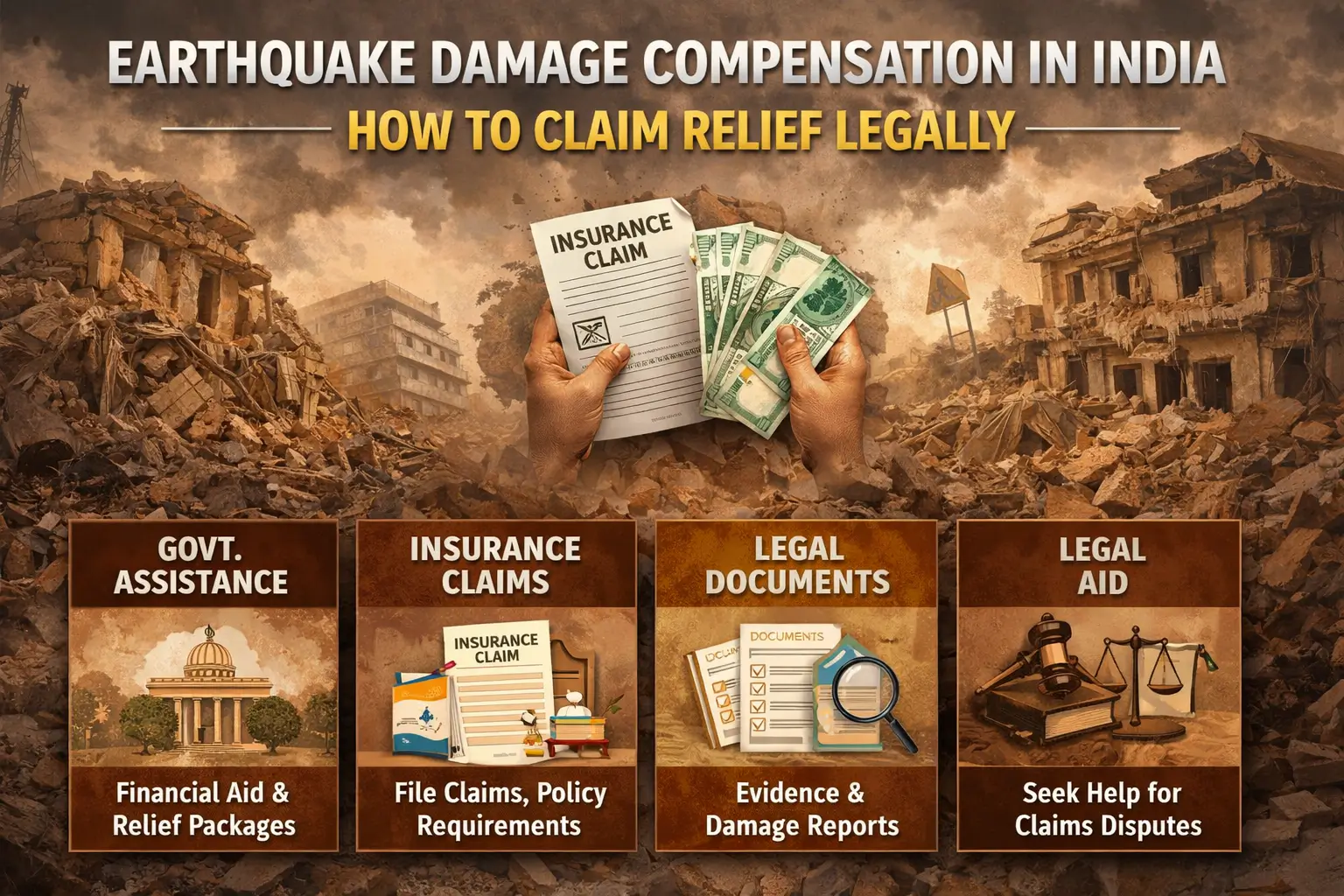
When an earthquake hits regions like Sikkim or any part of India, the immediate focus is survival and recovery. But once the situation stabilizes, the real problem starts—who pays for the damage?
Most people assume compensation is automatic. It’s not. Whether you receive compensation depends on government policies, insurance coverage, and how you legally claim it.
This guide explains the earthquake compensation law in India, what you can claim, and the exact legal steps to recover your losses.
Is Earthquake Compensation a Legal Right in India?
Here’s the reality: there is no universal law that guarantees full compensation for earthquake damage.
Relief is provided through:
- Government disaster relief schemes (NDRF/SDRF)
- Insurance policies (if you have coverage)
- Special state-level compensation programs
This means compensation is limited, conditional, and often delayed.
Government Compensation After Earthquake
The government provides relief under the Disaster Management Act, 2005. Funds are allocated through:
- National Disaster Response Fund (NDRF)
- State Disaster Response Fund (SDRF)
What You Can Expect
- Partial compensation for damaged houses
- Relief for loss of life or injury
- Limited support for livelihood loss
But understand this clearly: this is relief, not full compensation. It rarely covers actual market loss.
Eligibility Conditions
- Your property must be officially surveyed and recorded as damaged
- You must submit required documents to local authorities
- Assessment is done by government officials, not independent valuers
Insurance vs Government Relief: What Matters More?
If you have property insurance, that’s your primary protection.
Insurance Coverage
- Standard fire insurance policies may include earthquake coverage (if opted)
- Claims depend strictly on policy terms
- Surveyors assess actual damage before payout
Common Mistake
Most property owners either don’t have earthquake coverage or don’t understand exclusions. When disaster strikes, they discover they are not covered.
If your insurance claim is rejected or underpaid, you may need legal assistance under Civil & Property Law Services.
Legal Steps to Claim Earthquake Compensation
If your property is damaged due to an earthquake, follow a structured approach:
Step 1: Document the Damage
- Take photos and videos immediately
- Keep proof of ownership (sale deed, tax receipts)
Step 2: Inform Local Authorities
- Report damage to municipal or district authorities
- Ensure your property is included in official surveys
Step 3: File Insurance Claim (If Applicable)
- Notify insurer immediately
- Submit claim form with supporting documents
Step 4: Follow Up Relentlessly
Delays are common. If you don’t follow up, your claim will sit idle.
Step 5: Legal Action (If Needed)
If compensation is denied unfairly, you can:
- Approach consumer forums (for insurance disputes)
- File civil claims (in specific situations)
- Challenge arbitrary government decisions
For dispute handling, consult our Property Dispute Lawyers.
Who Is Liable for Earthquake Damage?
This is where most people get confused.
In general:
- No private party is liable for natural disasters
- Builders are liable only if construction defects caused additional damage
- Government provides relief, not liability-based compensation
If a building collapses due to poor construction, you may have a legal case against the builder or developer.
Special Cases Where Legal Claims Are Possible
You may have stronger legal grounds in the following situations:
- Structural defects in newly constructed buildings
- Violation of building safety norms
- Insurance claim rejection without valid reason
These are not disaster claims. These are legal liability cases.
Earthquake in Sikkim: What Changes Legally?
In regions like Sikkim, which fall under high seismic zones, stricter construction norms apply.
If authorities or builders ignored safety standards, liability can arise. But proving this requires:
- Technical evidence
- Expert reports
- Legal strategy
This is not something you handle casually. Most people lose such cases due to poor documentation.
Reality Check: Why Most People Don’t Get Full Compensation
- They rely only on government relief
- They don’t have proper insurance
- They fail to document damage properly
- They don’t challenge rejected claims legally
Compensation is not about entitlement. It’s about how well you claim it.
When Should You Consult a Lawyer?
You should seek legal help if:
- Your insurance claim is denied or delayed
- Your property loss is significant
- You suspect construction defects
- You are facing disputes over ownership or compensation
At Lawspicious, we handle compensation disputes, insurance conflicts, and property-related claims with a structured legal approach.
Call: +91 6289022944
Email: info@lawspicious.com