


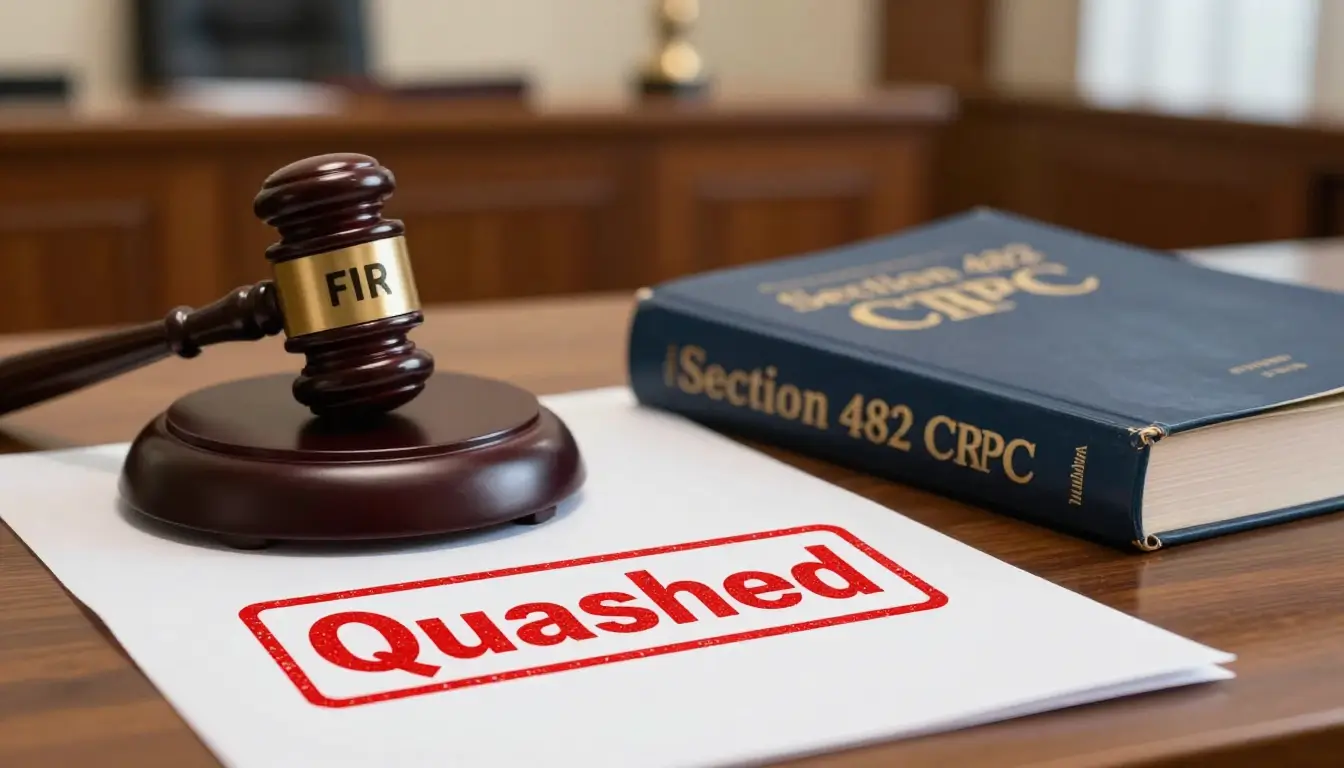
Quashing of FIR in India: Requirements, Procedure and Key Legal Principles
FIRs play an important role in initiating criminal investigations in India. However, the system is sometimes misused to harass innocent individuals through false, baseless or malicious complaints. In such cases, the affected person has the legal right to approach the High Court and seek quashing of the FIR under Section 482 of the Code of Criminal Procedure (CrPC).
This guide explains the legal basis, procedure, Supreme Court guidelines and the limits on court powers while quashing an FIR. For help with criminal matters or filing a quashing petition, you can visit:
Criminal Law Services – Lawspicious.
What Is FIR Quashing?
Quashing of an FIR means the High Court cancels the FIR and all related criminal proceedings when it believes that continuing the case would be unjust, abusive or without any legal basis.
Section 482 CrPC empowers the High Court to intervene in exceptional cases to:
- Prevent abuse of the legal process
- Ensure justice is served
The High Court uses this power sparingly and only when strong grounds exist.
Legal Basis for Quashing an FIR
Section 482 CrPC states that nothing in the CrPC limits the inherent powers of the High Court to pass orders necessary:
- To prevent abuse of the court process, or
- To secure the ends of justice
This ensures that criminal law is not used as a tool of harassment.
Procedure for Quashing an FIR
The procedure for quashing an FIR is straightforward, but it must be followed correctly.
1. Filing a Petition Under Section 482 CrPC
The accused files a quashing petition before the High Court that has jurisdiction over the police station where the FIR was registered.
2. Parties to the Petition
- Petitioner: The accused named in the FIR
- Respondents: The State and the original complainant
3. Court Hearing
The High Court hears both sides, reviews the FIR, witness statements, case documents and other materials on record.
4. High Court’s Decision
If the court finds the FIR false, malicious or without legal substance, it may quash it entirely.
For support with drafting and filing a quashing petition, you may contact:
Lawspicious – Contact Us.
Grounds on Which an FIR Can Be Quashed
While every case is unique, the Supreme Court has laid down guidelines to help High Courts decide when an FIR may be quashed. These principles were summarised in the landmark case State of Haryana vs. Bhajan Lal (1992).
The FIR may be quashed if:
- The allegations, even if fully accepted, do not constitute any offence.
- The FIR does not disclose any cognizable offence.
- The unchallenged allegations and evidence do not show the commission of any offence.
- The FIR includes only non-cognizable offences, where police cannot investigate without a Magistrate’s order.
- The allegations are absurd or highly improbable.
- A specific provision of law expressly bars such proceedings.
- The FIR appears to be maliciously filed with an ulterior motive.
These guidelines ensure that courts maintain consistency while protecting individuals from wrongful criminal proceedings.
Limits on the High Court’s Power to Quash FIRs
The High Court’s power under Section 482 CrPC is extraordinary but not unlimited. Courts must use it with caution.
- The power should be exercised sparingly and only in exceptional situations.
- Court cannot conduct a detailed inquiry or a mini-trial.
- The court cannot evaluate the reliability of allegations at this stage.
- Quashing must remain the exception, not the rule.
- The court must ensure that justice will be served by quashing the FIR.
These safeguards prevent misuse of the provision and preserve the balance between personal liberty and criminal justice.
When Should You Consider Filing for FIR Quashing?
You may consider approaching the High Court if:
- The FIR is false, frivolous or filed with bad intention.
- The dispute is purely civil in nature but wrongly converted into a criminal case.
- The parties have settled the matter amicably (in compoundable offences).
- The allegations are vague, baseless or legally unsustainable.
- You are being unnecessarily dragged into a case without involvement.
For advice on whether your FIR can be quashed, consult our litigation experts:
Litigation & Dispute Resolution.
Conclusion
The High Court’s power to quash an FIR is an important safeguard against injustice and misuse of criminal law. While the power must be exercised carefully, it gives protection to individuals facing frivolous, malicious or groundless criminal cases.
If you believe an FIR against you is false or motivated, Lawspicious can help assess your case and file a well-structured petition before the High Court.
For confidential legal guidance, visit:
Contact Lawspicious.
Frequently Asked Questions (FAQs)
1. Can the police investigate after an FIR is quashed?
No. Once the FIR is quashed, all related proceedings and investigations stop.
2. Can an FIR be quashed after chargesheet is filed?
Yes. The High Court can quash an FIR at any stage, even after filing of the chargesheet, if strong grounds exist.
3. Can the complainant oppose the quashing?
Yes. The complainant is a necessary party and can present objections in court.
4. Can FIRs in matrimonial cases be quashed?
Yes, especially when both parties have settled the matter and the offence is compoundable.
5. Is FIR quashing the same as acquittal?
No. Quashing stops proceedings at an early stage. Acquittal comes after trial.

One thought on “Quashing of FIR in India: Requirements, Procedure & Legal Grounds Explained”